Intelligent data compression: 2–3x more capacity from every SSD.
Inline data compression squeezes more data onto every SSD, reduces write amplification and lets your drives run faster, cooler and longer.
- Reduces write amplification
- Drives run faster, cooler, with a longer lifetime
- 2–3x more effective capacity
- Lower TCO per SSD
Free storage design session
30 minutes with an NVMe expert. No obligation.
Unpredictable write patterns wear out your NAND flash
They limit both the capacity and the performance of your SSD storage over time.
An SSD secretly writes more than you tell it to. When you save a 1 GB file, the drive may wear down its pages as if you wrote 2–3 GB, because of internal housekeeping: shuffling data around to keep things fast.
The result: two everyday problems
Your drive ages faster than it should
An SSD can only be rewritten a limited number of times before it wears out. Every extra internal write brings that moment closer.
It fills up faster than it should
Data takes up more physical space on the drive than it logically needs.
What compression does
It shrinks your data before it is written to the drive. Less wear, so the drive lives longer. More fits on it, so you store 2–3x more without buying a new drive.
How to benefit from compression on SSDs
NVMe SSDs with compression built in
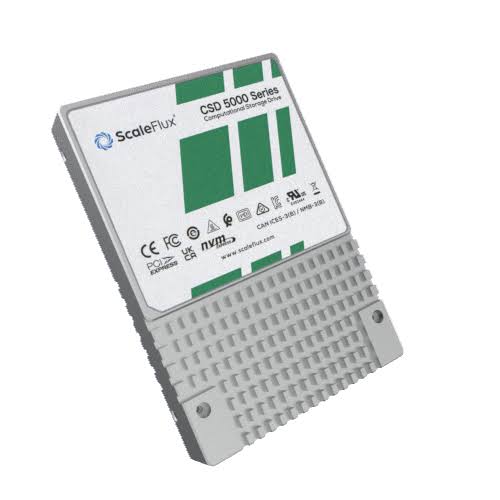
Buying new SSDs? ScaleFlux NVMe SSDs have compression built in, and data is written sequentially to the drive. 100% transparent to the OS and workloads: no modifications, no adjustments, immediate benefits.
Extend life or use lower-spec NVMe SSDs
With maxRAID software you benefit not only from more efficient RAID protection, but also from compression of the data. maxRAID writes all data sequentially to the drive: longer-lasting SSDs, lower TCO.
Density that saves rack space
Compression puts more terabytes on the SSDs in your servers. The result: more data stored per rack, less power, fewer servers for the capacity you need and a lower TCO.
Typical use
For everybody who operates and manages data storage infrastructure. Typical compression ratios:
- Log files: 8–15x
- Text and XML files: 4–8x
- Unstructured office data: 3–6x
- Virtual machine images: 3–5x
- Web content and HTML: 3–5x
- Databases: 2–4x
Delivered turnkey
Delivered as a turnkey solution in a JBOF or clustered configuration, or as NVMe SSD purchases. Want to know what compression does with your own data? Run our compression test.
From first call to running system
No one buys storage infrastructure on the first visit. We make the first step small and the rest predictable.
Free design session
Thirty minutes with an NVMe architect. We map your workload, capacity, performance targets and the constraints of your environment.
Validated design
You receive a sized configuration with a TCO comparison, pre-validated hardware and software, and a proof-of-concept plan if you want to test first.
Turnkey delivery
Pre-configured systems delivered and installed, with vendor support contracts in place. One contact for the whole stack.
Buying new NVMe SSD’s? Calculate your TCO in 2 minutes.
Open the TCO calculatorOther workloads
AI & real-time analytics
Fast block storage for read and write access to and from your GPUs. Ultra-low latency for training, feature stores and real-time inference.
See the design →LLM inference acceleration
Inferra by Lightbits: KV-cache tiering from GPU memory to NVMe so your inference clusters serve more tokens per GPU.
See the design →Kubernetes persistent storage
Persistent NVMe volumes over TCP/IP via CSI. Scale compute and storage independently, no special network.
See the design →Private cloud storage
One platform for block, file and object, on standard servers. Predictable cost, your data in-house.
See the design →Intelligent RAID protection for SSD
maxRAID: wear-aware rebuilds in minutes, full NVMe performance and 20% or less capacity overhead.
See the design →